


Los Angeles H-2B Visa Lawyer
Temporary Work Visas for Seasonal Workers
What Is an H-2B Visa?
The H-2B Visa Program allows U.S. employers or U.S. agents who meet specific regulatory requirements to bring foreign nationals to the U.S. to fill temporary nonagricultural jobs. The program allows foreign nationals to work for a sponsoring employer to fill seasonal positions, on one-time projects, during times of exceptionally high workload, or intermittently.
At Bolour / Carl Immigration Group, APC, our Los Angeles H-2B visa lawyers help employers and workers move through each stage of the program.
The H-2B Visa Program is designed to benefit various American industries, including landscaping, seasonal hospitality, seasonal construction, manufacturing, food packaging and processing, retail, and others. The program helps employers who need temporary services or labor bring foreign workers to the U.S. when domestic workers are not available to provide that labor.
Demand for drivers has made H-2B visas for truck drivers a common question, since trucking and transportation companies continue to struggle to hire enough drivers domestically. If you are interested in coming to America to work as a truck driver, the H-2B program is one path to explore.
H-2B Visa Requirements
To qualify for H-2B nonimmigrant classification, the petitioner (employer) must establish that:
- There are not enough U.S. workers who are able, willing, qualified, and available to provide the temporary services or labor;
- Employing H-2B workers will not adversely affect the wages and working conditions of similarly employed U.S. workers; and
- The petitioner’s need for the prospective worker’s services or labor is temporary, regardless of whether the underlying job can be described as temporary.
The petitioner must also submit a single valid temporary labor certification from the U.S. Department of Labor (DOL) along with the H-2B petition. The employer’s need is considered temporary if it is a one-time occurrence, a seasonal need, a time of exceptionally high workload, or an intermittent need.
Before requesting H-2B classification from U.S. Citizenship and Immigration Services (USCIS), the petitioner must apply to the DOL for a temporary labor certification and receive it. After receiving the certification, the petitioner must file Form I-129, Petition for a Nonimmigrant Worker, with USCIS on the prospective employee’s behalf.
A Complex Application Process
The H-2B visa application process is complex and breaks down into three distinct phases:
- The employer applies for labor certification from the Department of Labor. This phase includes conducting a labor market test with the State Workforce Agency where the work will be performed.
- The employer petitions USCIS for approval to hire a specific number of workers under the H-2B visa classification.
- After USCIS approves the petition, workers apply for their H-2B visa at a Department of State visa-issuing embassy or consulate abroad.
The labor market test in the first phase can take months, so the full timeline usually begins well before the job’s start date.
Number of H-2B Visas Available
H-2B visas are typically capped at 66,000 annually. Half of them, 33,000 visas, go to workers with job start dates in the first half of the fiscal year, October 1 to March 31, and the other half are reserved for workers who begin working April 1 to September 30. Demand typically far exceeds availability, especially for the spring and summer months, so the process is competitive and application timing is crucial.
Applications submitted during the peak three-day window at the beginning of January for jobs with start dates of April 1 or later are randomly assigned to groups, with those in Group A processed first. In 2021, 5,403 applications requesting more than 96,888 positions were received during the three-day peak filing window at the start of the year.
Certain H-2B workers are exempt from the cap. These include workers hired for certain fish roe positions along with workers already in the United States on an H-2B visa who extend their stay, change employers, or change the terms and conditions of their employment.
H-2B Visas for Truck Drivers
To qualify for an H-2B visa as a truck driver, you must be at least 18 years old. While commercial driver’s licenses (CDLs) issued in Mexico and Canada are valid in the United States, other drivers will need to pass a test and receive their U.S. CDL before beginning work. Your employer is responsible for ensuring that you are trained and licensed.
H-2B visas are available to citizens of about 80 countries approved by the Department of Homeland Security (DHS). The approved countries list, which DHS updates periodically, includes Mexico, Canada, and nations from all regions of the world.
H-2B Visas for Construction Workers
Depending on their business, some construction companies may have a seasonal need for workers. For instance, a pool construction company may only have projects during certain times of the year. More commonly, construction companies have a peak-load need for workers, which means they supplement permanent staff with temporary workers to meet a seasonal or short-term demand.
A construction company whose focus includes K-12 school renovations, for example, may have more projects, and therefore more demand for workers, during the summer, when schools are closed. Similarly, a company with a concentration on outdoor projects may have more demand during the more temperate months of the year, when a greater number of projects happen.
Applying for an H-2B Visa While in the United States
If you’re already in the U.S., an H-2B visa lawyer can help. We assist both employers and workers through the complexities of immigration law, so that all requirements are met efficiently and effectively.
Eligibility and Requirements
The H-2B visa is designed for temporary or seasonal non-agricultural work. Unlike other work visas, it is open to occupations beyond specialty ones. To qualify, the job must be temporary in nature, such as a peak load need, seasonal need, intermittent need, or one-time occurrence. The first step for an employer is to prove that there are not enough U.S. workers who are able, willing, qualified, and available to do the temporary work.
For workers applying from within the U.S., it’s essential to verify that your current status allows you to change to an H-2B visa. A lawyer who specializes in temporary work visas for seasonal workers can help you get started.
Steps in the Application Process
The process begins with the employer filing a Temporary Labor Certification for H-2B workers with the U.S. Department of Labor (DOL). This certification must demonstrate the temporary nature of the job and the lack of available U.S. workers. Once the labor certification is approved, the employer must then file Form I-129, Petition for a Nonimmigrant Worker, with U.S. Citizenship and Immigration Services (USCIS).
Important Considerations
When applying to change your status to H-2B within the United States, it’s crucial to maintain legal status throughout the process. If your current visa expires before your H-2B application is approved, you could be found to be out of status, which might jeopardize your ability to stay in the U.S. H-2B visas are also capped annually, and only a certain number are available each fiscal year, so timing your application correctly is essential.
While you can legally stay in the U.S. while your change of status application is pending, you should not start working in the H-2B position until your application has been approved. Doing so could lead to violations of your current visa conditions and affect your H-2B status.
How We Can Help
At Bolour / Carl Immigration Group, APC, we have years of experience guiding clients through the H-2B visa application process. We understand the complexities involved and provide personalized assistance to meet the specific needs of both employers and workers. Our goal is to prepare an application that is complete, accurate, and timely.
Why Early Planning Matters for H-2B Employers and Workers
If you’re currently in the United States and considering an H-2B visa, or if you’re an employer looking to hire foreign seasonal workers, timing shapes almost every decision, from the labor market test to the cap filing window. Talking through your situation with an H-2B visa lawyer early on helps clarify your options and the path forward.
What to Do if Your H-2B Application Was Denied
The H-2B program offers temporary work visas for seasonal workers, but what happens if your application is denied? At Bolour / Carl Immigration Group, APC, we’ve helped thousands of clients with their visa applications since 1996. The sections below cover what to do after an H-2B denial.
Common Reasons for Denial
There are several reasons why an H-2B application might be denied. Understanding these reasons can help you address the issues and strengthen a future application. Some common reasons for denial include insufficient documentation, failure to meet eligibility requirements, or issues related to the employer’s need for temporary workers.
Reviewing the Denial Notice
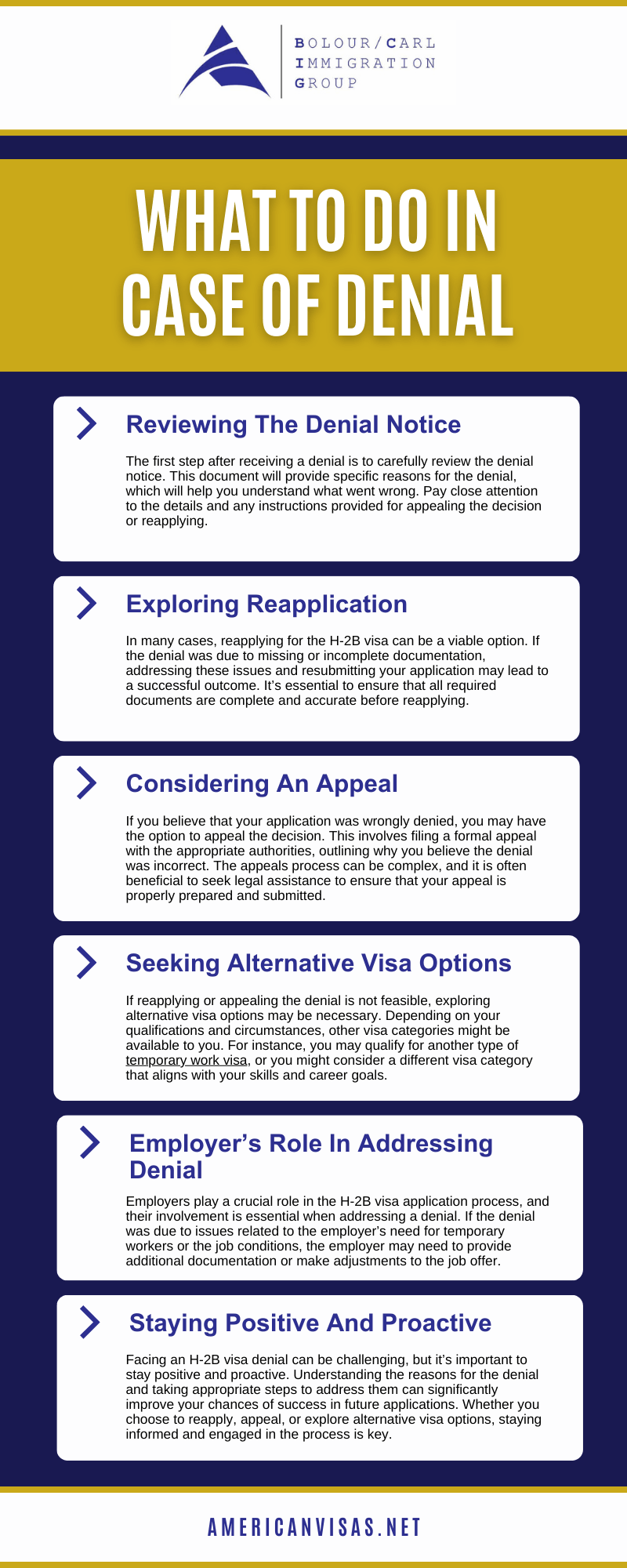
The first step after receiving a denial is to review the denial notice carefully. This document provides specific reasons for the denial, which will help you understand what went wrong. Pay close attention to the details and any instructions provided for appealing the decision or reapplying.
Exploring Reapplication
In many cases, reapplying for the H-2B visa can be a viable option. If the denial was due to missing or incomplete documentation, addressing these issues and resubmitting your application may lead to a successful outcome. It’s essential to ensure that all required documents are complete and accurate before reapplying.
Considering an Appeal
If you believe that your application was wrongly denied, you may have the option to appeal the decision. This involves filing a formal appeal with the appropriate authorities, outlining why you believe the denial was incorrect. The appeals process can be complex, and legal assistance helps ensure that the appeal is properly prepared and submitted.
Seeking Alternative Visa Options
If reapplying or appealing the denial is not feasible, exploring alternative visa options may be necessary. Depending on your qualifications and circumstances, other visa categories might be available to you. For instance, you may qualify for another type of temporary work visa, or you might consider a different visa category that aligns with your skills and career goals.
Employer’s Role in Addressing Denial
Employers play a crucial role in the H-2B visa application process, and their involvement is essential when addressing a denial. If the denial was due to issues related to the employer’s need for temporary workers or the job conditions, the employer may need to provide additional documentation or make adjustments to the job offer.
Staying Proactive After a Denial
Facing an H-2B visa denial can be challenging, but a proactive approach helps. Understanding the reasons for the denial and taking appropriate steps to address them can strengthen future applications. Whether you choose to reapply, appeal, or explore alternative visa options, staying informed and engaged in the process is key.
Reviewing a Denial Early
At Bolour / Carl Immigration Group, APC, we help clients work through the challenges of an H-2B visa denial. Reviewing the denial notice and the underlying petition early leaves more room to choose between reapplying, appealing, and exploring other options.
H-2B Nonimmigrant Visa Program Infographic
H-2B Visa Lawyer FAQs
When you’re coming to the U.S. for work, an H-2B visa lawyer can help you move through each step. At Bolour / Carl Immigration Group, APC, we’ve helped clients manage the immigration process since 1996, whether they’re individuals, families, or businesses, and the answers below cover how the H-2B visa works.
What Is the Advantage of the H-2B Visa?
The H-2B visa offers several advantages for both employers and workers. For employers, it allows the hiring of foreign workers to fill temporary non-agricultural jobs, such as in tourism, hospitality, landscaping, and construction. This is particularly helpful during peak seasons when there is a high demand for labor.
For workers, the H-2B visa provides a chance to work legally in the United States for a specified period, with the potential to return for multiple seasons. It’s an avenue for gaining work experience in the U.S., often leading to better employment opportunities in their home country or potential future U.S. employment.
How Does the H-2B Visa Application Process Work?
An employer must first file a temporary labor certification application with the U.S. Department of Labor (DOL) to demonstrate that there are not enough U.S. workers who are able, willing, qualified, and available to perform the work.
Once the DOL approves this certification, the employer then files Form I-129, Petition for a Nonimmigrant Worker, with U.S. Citizenship and Immigration Services (USCIS). After this petition is approved, the foreign worker can apply for the H-2B visa at a U.S. consulate or embassy in their home country.
What Industries Commonly Use the H-2B Visa Program?
The H-2B visa program is widely used in industries that experience seasonal or peak load needs. Some of the most common industries include hospitality, landscaping, construction, and seafood processing. For example, during the summer months, hotels and resorts may require additional staff to handle the influx of tourists, or landscaping companies may need extra workers to manage the surge in demand for services.
How Long Can Someone Stay in the U.S. on an H-2B Visa?
The initial period of stay for an H-2B visa holder is typically up to one year. However, the visa can be extended in increments of up to one year, with a maximum total stay of three years. After three years, the visa holder must leave the U.S. for at least three months before they can apply for another H-2B visa. If you have questions about coming and going from the U.S. in the meantime, an H-2B visa lawyer can help.
Who Can Sponsor H-2B Workers?
To sponsor an H-2B worker, the sponsor must be a U.S. employer with a temporary need for labor that falls outside of agricultural work. The employer must prove that the job is temporary in nature and that there are no qualified U.S. workers available to fill the position. The employer must also demonstrate that hiring foreign workers will not negatively affect the wages and working conditions of similarly employed U.S. workers.

H-2B Visa Glossary
The H-2B visa program provides an essential legal path for U.S. employers to fill temporary non-agricultural job openings with foreign workers. It plays a vital role in supporting industries that rely on seasonal labor, such as construction, hospitality, food processing, landscaping, and transportation. This glossary includes key legal terms and procedures frequently encountered in the H-2B process. Whether you’re an employer or a foreign worker, understanding these terms can help you stay informed and prepared throughout each phase of the visa application.
Temporary Labor Certification
A Temporary Labor Certification is a document issued by the U.S. Department of Labor (DOL) that an employer must secure before petitioning for H-2B workers. The certification confirms that there are not enough qualified and available U.S. workers to perform the temporary job and that hiring foreign labor will not adversely affect the wages or working conditions of similarly employed U.S. workers. This step is foundational in the H-2B visa process and must be completed before the employer can file Form I-129 with USCIS.
This certification includes a labor market test through the State Workforce Agency. Employers must demonstrate diligent efforts to recruit U.S. workers first, including specific advertising requirements. The labor need must clearly fit into one of the approved categories: seasonal, intermittent, peak load, or one-time occurrence. Employers who cannot justify the temporary nature of the job will not receive certification.
Form I-129: Petition for a Nonimmigrant Worker
Form I-129 is filed with U.S. Citizenship and Immigration Services (USCIS) by the employer after receiving temporary labor certification. It petitions the government to classify a specific number of foreign workers under the H-2B category. This form must include evidence supporting the approved labor certification and the temporary need. Without an approved I-129 petition, foreign workers cannot apply for their visa through a U.S. embassy or consulate.
Supporting documents may include the approved DOL certification, job descriptions, details of the employer’s business operations, and evidence that the requested employment falls within the authorized visa timeframe. USCIS review includes a verification of the employer’s legal status and the consistency of information across the documentation provided.
Cap Allocation
The cap allocation limits the number of H-2B visas that can be issued each fiscal year. The cap is currently 66,000 annually, split between two periods: 33,000 visas for jobs starting between October 1 and March 31, and another 33,000 for positions starting between April 1 and September 30. Because demand often exceeds supply, application timing plays a critical role. Employers must submit their applications during narrow filing windows to increase their chances of selection.
During high-demand cycles, applications are grouped randomly and assigned processing priority. Workers already in the U.S. on H-2B status who are extending or amending their employment may be exempt from the cap. The Department of Homeland Security may also increase the cap temporarily under certain conditions if unmet labor demand persists in specific industries.
Seasonal Need
A seasonal need refers to an employment requirement that occurs during a specific time of the year and recurs annually. This is one of the qualifying categories for H-2B eligibility. The job must be tied to a season or event that is predictable and limited in duration. Landscaping in spring and summer, or hotel staffing during holiday tourism seasons, are common examples.
The employer must present credible documentation showing that the workload rises during this specific period each year and cannot be managed by existing staff. Tax records, client contracts, and historical staffing data are often included in the evidence submitted with the certification request.
Change of Status
A change of status allows a foreign national already in the U.S. under a different visa classification to legally switch to H-2B status without leaving the country. To qualify, the applicant must maintain valid nonimmigrant status at the time of filing and remain in compliance with all visa conditions. The process begins with the employer filing Form I-129, along with evidence supporting the H-2B request and proof of the applicant’s current lawful status.
Applicants may remain in the U.S. while the change of status petition is pending but cannot begin work in the H-2B position until approval is granted. If the individual’s current status expires before the petition is approved, they could be out of status, which may affect eligibility for future immigration benefits. Applicants should avoid unauthorized employment and monitor timelines closely throughout this process.
Talk With a Los Angeles H-2B Visa Lawyer About Your Petition
At Bolour / Carl Immigration Group, APC, we help employers and workers across industries move through every step of the H-2B visa process with clarity and direction. We provide guidance with filing, documentation, and timing, helping our clients avoid delays and missed opportunities. If you’re an employer looking to supplement your seasonal workforce or a worker seeking lawful employment in the U.S., contact us to schedule a consultation with a Los Angeles H-2B visa lawyer.

Looking for Experienced Immigration Attorneys?
